


Nike



NIKE, THE BENCHMARK SNEAKER BRAND
BILL BOWERMAN AND PHILIP H. KNIGHT, THE NIKE SUCCESS STORY
When Nike is mentioned, people immediately think of a powerful and committed brand, but above all of a logo recognizable among thousands. In 1964, while the sportswear and sporting goods market was largely dominated by German companies, Americans William J. Bill Bowerman and Philip H. Knight decided to join forces to found a sports brand capable of competing with the many European rivals. Philip Knight, an accountant by training and a long-distance runner, teamed up with Bill Bowerman, coach of Oregon's track and field team, to create a less expensive brand accessible to athletes. Nike was initially called Blue Ribbon Sports. Bowerman notably served as a technical advisor within the company and used his position as a coach to test products directly with athletes. In 1965, they were both joined by Jeff Johnson, a full-time salesman, who would establish the company's guiding principle, still relevant today: staying as close as possible to the athlete and their needs. He also came up with the name Nike, directly inspired by the goddess Nike, symbolizing victory and determination.
NIKE SNEAKERS: WHEN THE SWOOSH BECOMES ICONIC
Nike was imagined by athletes, for athletes. That is how the brand stands out and forged its way up to the level of its biggest competitors: Adidas and Puma. Its logo, the classic Swoosh, is considered one of the most striking and successful in marketing and communication. As for the story, it was created by a graphic design student, Carolyn Davidson, for the modest sum of 35 dollars. Today, it has brought the company billions!
Behind some of the greatest sneaker classics with silhouettes like the Air Force, the React Element or the Air Max, the brand with the Swoosh keeps reinventing itself, much to our delight.
TOP-TIER NIKE COLLABORATIONS: TRAVIS SCOTT, NOCTA, JACQUEMUS AND CORTEIZ
Nike is undoubtedly one of the most popular and influential companies of our time. The brand with the Swoosh is now a symbol of creativity and performance, notably thanks to its influential and talented ambassadors. Among them is the world-famous rapper Travis Scott; the Houston native continues to collaborate with the brand by reworking iconic models such as the Nike Air Force 1 and the Air Jordan 1. His Canadian counterpart, Drake, went even further by creating the NOCTA sub-label at Nike. Through this sub-division, the Toronto-born artist unveiled the Hot Step Terra and the Glide in several variations.
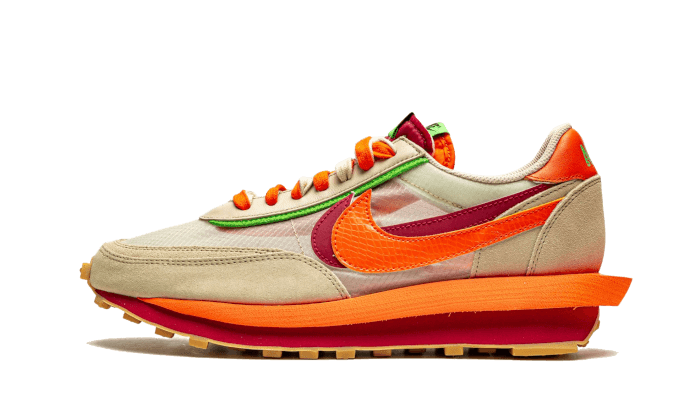
The strength of Nike lies in the diversity of its ambassadors, where every form of art is represented by creators such as Jacquemus, Sacai, and the luxury house Tiffany. More recently, the Swoosh brand even collaborated with the British label that has made a lot of noise in recent months, Corteiz, around three brand-new colorways of the Air Max 95. And this collaboration could continue in 2024 on the Air Trainer Huarache.
Nike is not just a brand offering sportswear items; it is an entity that influences sport, the sneaker world, and the luxury space alike. Between the customization program with Nike by You and the immersive experience with Paris On Air, the American giant puts its consumers at the heart of its values. Nike was able to be first to take the initiative and continues to innovate in order to remain the leader in its sector.
AIR JORDAN: HIS AIRNESS TURNS THE WORLD OF SNEAKERS UPSIDE DOWN
In 1985, the Beaverton-based brand decided to sign an exclusive contract with a young rookie from the University of North Carolina, Michael Jordan. This gave rise to the greatest collaboration between an athlete and a sportswear brand, the Air Jordan line. To bring the collaboration's universe to life, the Nike teams called on Peter Moore, an American footwear designer who, that same year, designed the Nike Dunk for the Be True to Your School pack, intended to support the feet of players from the best college basketball teams such as those of Iowa, Syracuse, and Kentucky. The Air Jordan 1 High and the Air Jordan 1 Low were born. They stand out from the Dunk thanks to their higher, sharper silhouette and their Wings logo and their Air capsule hidden beneath the sole for revolutionary comfort and cushioning at the time. Early OG colorways such as the Chicago, the Bred, and Neutral Grey were a phenomenal success and are now true relics for collectors around the world. The collection stands out for the release pace of its models. Indeed, for each NBA season, a Air Jordan model was unveiled at the beginning of the year. In 1986, Nike called on Bruce Kilgore, creator of the iconic Nike Air Force 1 to design the Air Jordan 2. The second signature model was intended to be more luxurious; entirely made in Italy, it featured premium leather. Unfortunately too expensive for the time, the model failed to find its audience and would be regarded as the most unloved Jordan. This slight decline impacted Michael Jordan, who wanted to leave Nike for another equipment supplier, but the Beaverton brand called on the man who would change the company's image forever, Tinker Hatfield. He focused primarily on the requests of the Chicago Bulls player, seeking to provide him with a design that was both comfortable and high-quality. From this collaboration came the Air Jordan 3 in 1987, a true aesthetic and technological revolution thanks to its visible Air unit like on the Air Max 1, its Elephant Print running across the upper, and the creation of the Jumpman logo. Combined with M.J.'s exceptional on-court performances and his new title of All-Star Game MVP, the sneaker was a runaway success and managed to convince His Airness to stay with Nike. This marked the beginning of a long collaboration between the Jordan and Hatfield duo. The pairing continued the following year with the Air Jordan 4. From the late 80s to the early 2000s, the player's signature silhouettes continued to amaze his fans. Today, thanks to the retro trend, several shoes from the past are back in the spotlight, like the hugely popular Air Jordan 1 Mid as well as collaborative designs with artists like Virgil Abloh for Off-White.
NIKE DUNK & DUNK LOW
At the beginning of the 1980s, the basketball shoe market was largely dominated by Adidas and Converse. Adidas, thanks to its exclusive contracts with legendary players like Kareem Abdul-Jabbar, and Converse, which held an almost complete monopoly on the market thanks to the All Star Chuck Taylor. It was in 1985 that Nike, initially known for its running models such as the Waffle Trainer and the Cortez, decided to take on the hardwood. It turned to Peter Moore, a footwear designer who created the Nike Dunk. Its name comes from the spectacular move in which the player jumps high enough to tip the ball into the hoop without taking their hand off the ball. The goal? To outfit players from the biggest college basketball teams. An exclusive contract was then signed between the sportswear brand and the following universities: Iowa, Syracuse, St. John, Kentucky, Georgetown, Michigan and UNLV. Seven pairs of Nike Dunk High were therefore introduced as part of the Be True To Your School pack. Over the years, the skateboarding community reclaimed the model thanks to its flat sole and grippy outsole, which makes tricks easier without damaging the durable upper. Its accessibility made it a must-have for all skateboarding enthusiasts. Released a few years later, the Nike Dunk Low would enjoy major popularity in the early 2000s thanks to Nike SB editions in collaboration with Supreme or Jeff Staples. It was not until 2020 that a revival of the Dunk emerged through popular and iconic names such as Skate Like a Girl and artist Travis Scott.
NIKE MIND 001
In 2026, Nike made a radical shift with the launch of a brand-new silhouette: the Nike Mind 001. The first sneaker born from a collaboration between the design teams and the brand's biomechanical research labs, the Mind 001 is not simply a new pair — it is a scientific breakthrough made wearable. For this silhouette, Nike developed a fully reengineered cushioning system, designed using data collected from thousands of strides to deliver unmatched ground response in the world of lifestyle footwear.
The sole features a new-generation foam with energy-return properties previously reserved for premium competition-grade running shoes. The upper, meanwhile, uses lab-developed materials that dynamically adapt to the shape of the foot. The result is a sneaker that pushes the limits of what a pair of lifestyle can offer in terms of performance and comfort.
AIR MAX
In 1986, Tinker Hatfield, a recent architecture graduate from the University of Oregon, joined the Nike team to design new models. It was during a trip to Paris that the young Tinker found the inspiration for the silhouette that would revolutionize the industry: the Air Max. The structure of the Centre George Pompidou, its color code, and its facade made of transparent tubes were the main inspirations behind the legendary Air Max 1 OG White Red, released in 1987. It was not until 1990 that the line evolved with the iconic Air Max 90 and its Infrared colorway. Today, both models are the subject of highly sought-after collaborations with the Patta store, as well as the Nike Off White line.


