







































Sebago


SEBAGO, THE HAND-SEWN PENNY LOAFER MOCCASIN SINCE 1946
1946, THREE ASSOCIATES FOUND SEBAGO ON THE EDGE OF A LAKE IN MAINE
In January 1946, three friends founded the Sebago-Moc Company in Maine. One of them owns five independent shoe stores and is unable to supply them properly: rather than looking for another supplier, he partners with two local businessmen to set up his own factory. Daniel Wellehan, William Beaudoin and Joseph Cordeau thus give birth to a factory born from a supply problem.
The name is chosen deliberately: Sebago is a lake in Maine. Geographic anchoring is part of the brand from day one. Their founding product is the Classic beefroll penny loafer, a hand-sewn moccasin that the house still makes today exactly as originally. Success was immediate across the country: one million pairs sold by 1954.
FROM PENNY LOAFER TO DOCKSIDES, CAMPSIDES AND CITYSIDES
Contrary to what we often read, Sebago was not born from sailing. THE Docksides arrived in 1970, a quarter of a century after the moccasin, and for a very concrete reason: the leaders of the late 60s were themselves passionate sailors and wanted a hand-sewn leather boat shoe. Followed by the Campsides in 1981, a blucher moccasin, then the Citysides line for the city. The brand became the official supplier of the American sailing team in the 1980s.
The Classic Dan therefore remains the direct descendant of the 1946 shoe. Unlined full-grain leather, hand-stitched upper, molded rubber heel: nothing has changed, and that's the point. Production is now carried out in Dominican Republic, where BasicNet has refocused it since the 2017 takeover to improve quality.
WHY THE FRENCH BELIEVED THAT SEBAGO WAS A LOCAL BRAND
It is the most unknown uniqueness of the house. Thanks to European distributors recruited in the 1960s, Sebago has long sold more on the old continent than on its domestic market. Its main markets: France, Belgium, Germany, Spain, Portugal, Switzerland and Scandinavia.
French adoption was even such that, in the 1970s, and particularly on the coast, certain buyers ended up believing in a French brand. A mistake that says a lot about the way in which the moccasin has blended into the French coastal wardrobe – beach, pontoon, terrace – to the point of appearing native.
HOW TO WEAR THE CLASSIC DAN MOCCASIN BY SEBAGO
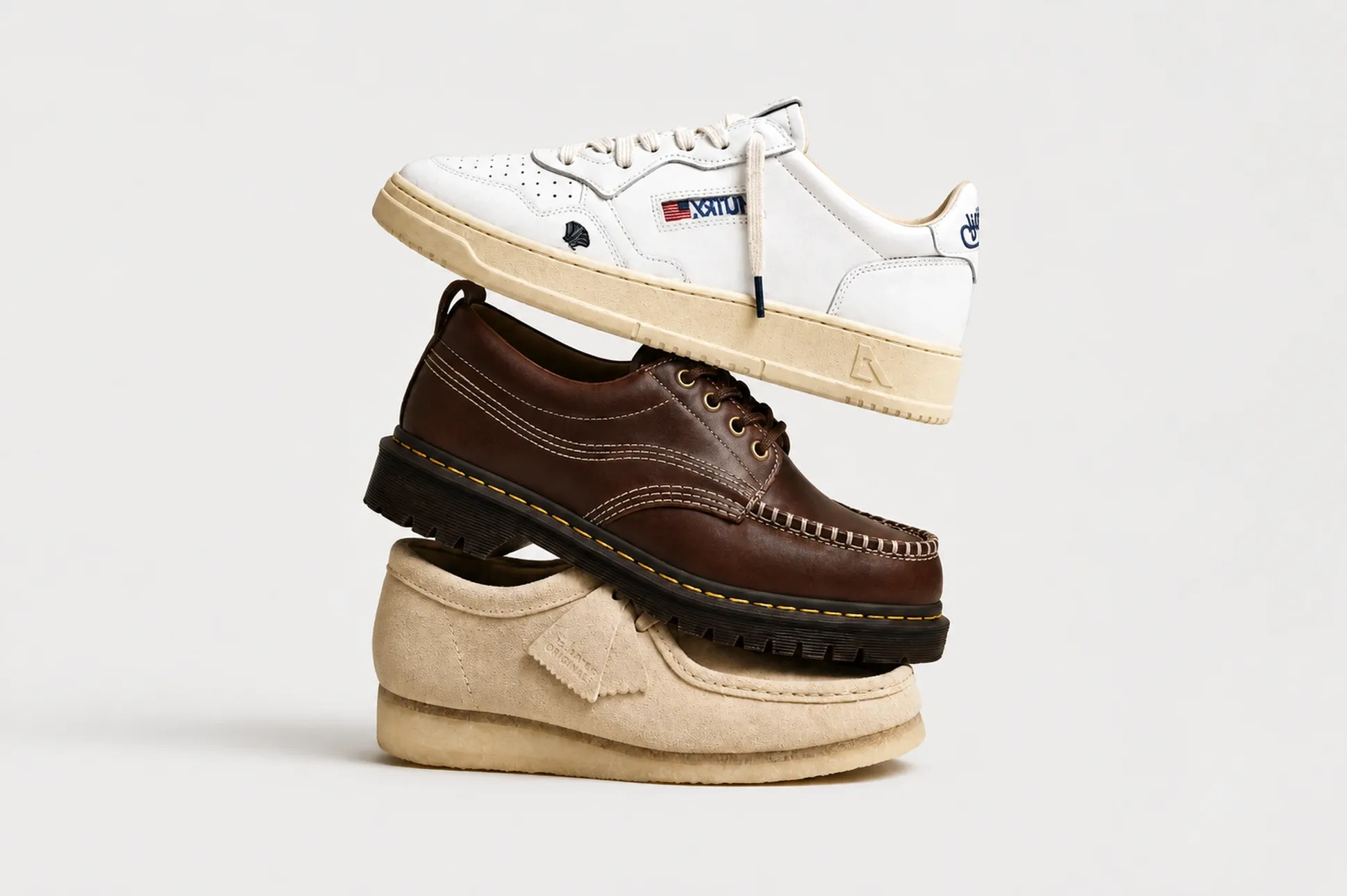
In a contemporary wardrobe, the Classic Dan plays the role of a Clarks Wallabee : a leather shoe which replaces the sneaker without going formal, at ease with wide pants or raw jeans. The crossover is not theoretical, since the brand has signed a collaboration with Bisous Skateboard.
Two practical tips. The Classic Dan fits large: between two sizes, take the smallest, the unlined leather softens significantly. And count on a few outings before it wears on your feet — it's not a moccasin that cheats on immediate comfort.


